
Sealed on Zyn.
Anchored in Zcash.
Every epoch seals the ledger into one state root, laid down on top of the last. The operator writes those roots into ordinary Zcash transactions, so each anchored layer is pinned to a Zcash block that anyone can look up. Every ZEC withdrawal carries one; otherwise one goes out at most once a day.
Our flagships
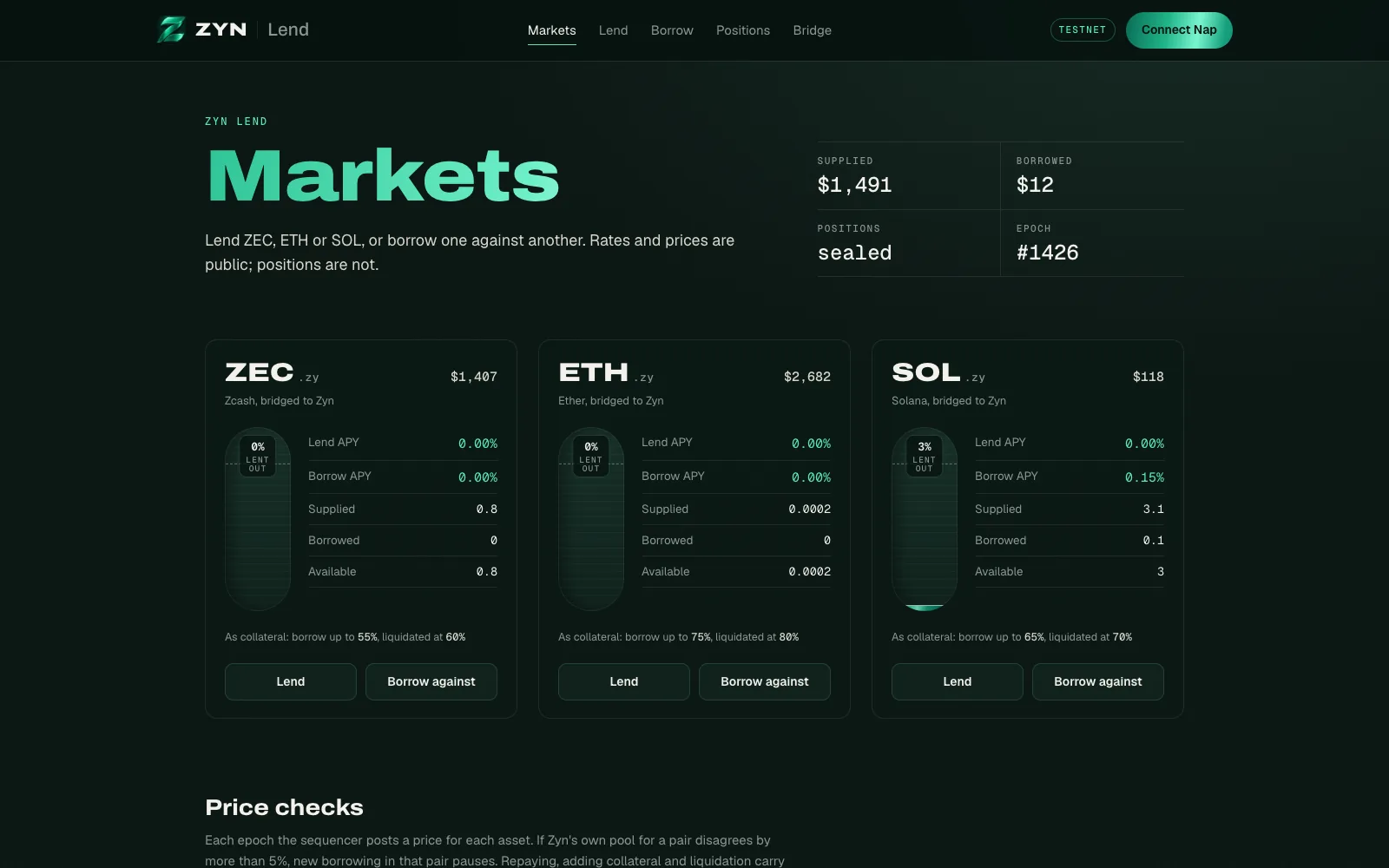
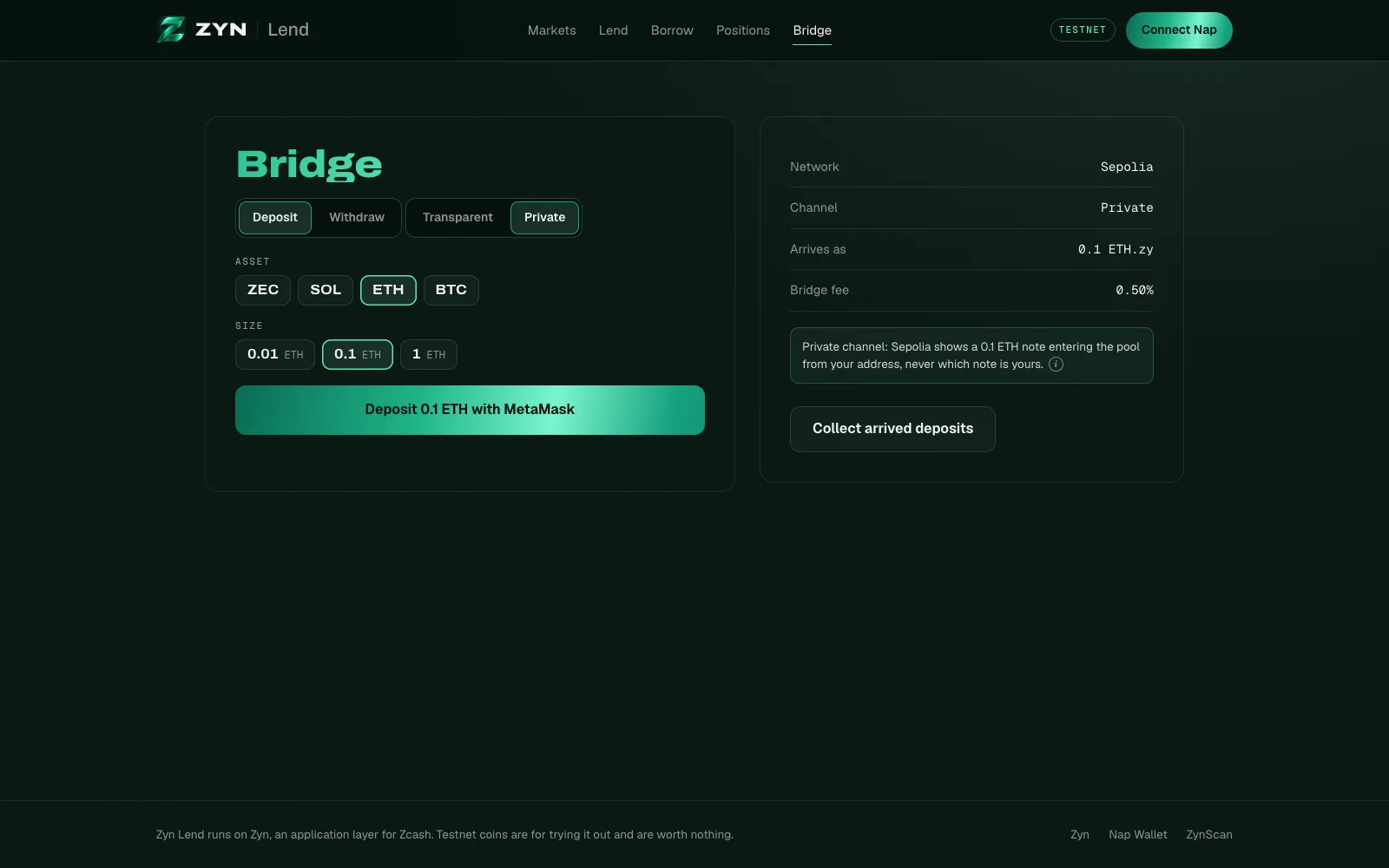
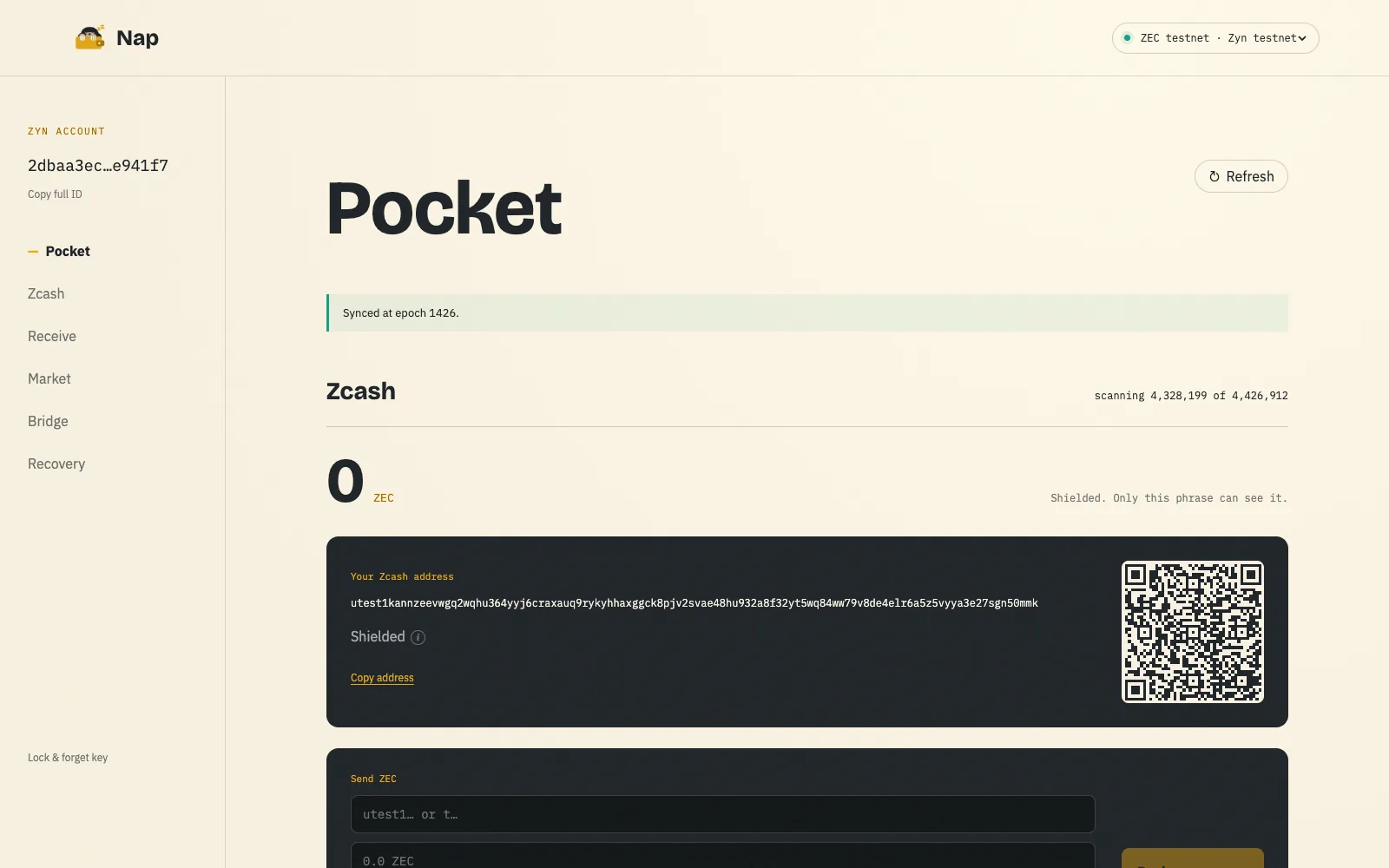
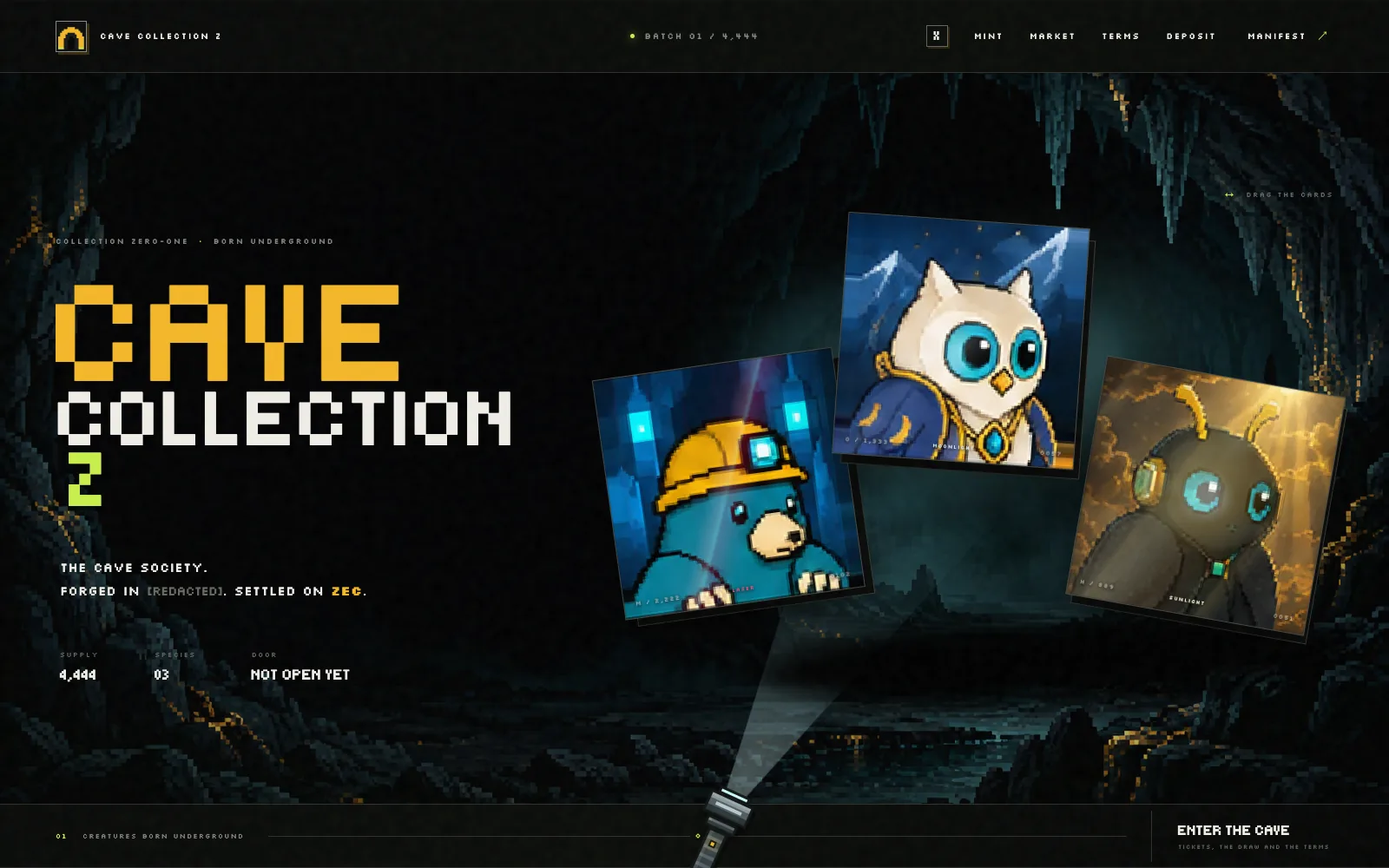
The apps the Zyn team runs, captured from their live addresses.
Ask the ledger yourself.
ZynScan's API is public and needs no key. This is the newest sealed epoch, fetched when you opened this page.
$ curl https://zyn-rpc.cavebro.win/scan-testnet/api/epochs
…
Build on Zyn
Zyn is not open for outside apps yet. In the first phase we build with a small number of teams: an app that needs new rules runs as a module in the ledger and is added with us. These are the areas we are looking for.
-
Private DeFi
Lending, swaps, stablecoins and structured products where positions stay private.
Talk to us -
Launchpads & communities
Coins, collections and sales on Zyn's curves, pools and draws.
Talk to us -
Wallets & payments
Nap Connect on your site, checkout in ZEC.zy and bridged assets, bots and alerts.
Talk to us -
Infrastructure
Run a replica that rebuilds every root, hold a custodian key share, operate a relayer or an indexer.
Talk to us -
Build without us
Any site can use Nap Connect and the public API today, with no key. The Cave store and Zyn Lend are built this way.
Open ZynScan -
Join the team
Engineers who know Rust, zero-knowledge proofs or Zcash, frontend builders, and people who run infrastructure.
Write to the team
What you are trusting
One operator orders transactions. Zyn is operator-sequenced, with no fraud proofs and no validity proofs.
Withdrawals depend on our custodians. Bridged ZEC is backed by ZEC in a 2-of-3 threshold vault run by the Zyn team. Bridged ETH and BOLD sit in an unaudited contract that answers to the team's 2-of-3 Safe.
Zcash keeps time; it does not check our work. It records deposits, withdrawals and anchor commitments, but does not validate Zyn state transitions. Zyn does not inherit Zcash's security.
Private from the public, visible to the operator. Who holds and trades what is not published. The operator and authorised verifiers can see it today; we are working toward a version where they cannot.
Hallmarks
Precious metal carries stamps anyone can check. These are Zyn's, and none of them needs our help.
- BACKED
Issued against the vault. The ledger publishes what it has issued per asset; the bridge checks the vault still holds it every pass, and you can compare the same figure with the vault's balance on Zcash.
- REPLAYED
Rebuilt from the journal. ZynScan replays every sealed epoch and reports whether its root matches the node's.
- ANCHORED
Written into Zcash. Once a root is anchored, changing it would contradict a Zcash block.
- SEALED EXIT
Destination kept to one reader. A withdrawal records only a hash of where money goes; the address is shown to the bridge that pays it.
Questions
Straight answers, including the uncomfortable ones. The short version is in what you are trusting.
What is Zyn?
An application execution layer built for Zcash. It runs deterministic application state machines (a wallet, lending, a market, a launchpad, a collection), batches their activity into epochs, and anchors each sealed state root to Zcash.
Is Zyn a Zcash layer 2, a rollup or its own chain?
No. Zyn is operator-sequenced: one sequencer orders transactions, and there are no fraud proofs or validity proofs. Zcash records its deposits, withdrawals and anchor commitments but does not validate its state transitions, so Zyn does not inherit Zcash's security. Built for Zcash, not part of it.
How do I start?
Open Nap Wallet in your browser, or install it in Chrome (download the zip, unzip it, then Load unpacked in chrome://extensions with Developer mode on). Create or restore a wallet with a 24-word recovery phrase. There is no account server: your keys are derived on your device. Try it on testnet first; testnet coins are worth nothing.
How does ZEC get in and out?
Send shielded ZEC to your Nap deposit address and it arrives on Zyn as ZEC.zy. Withdrawing burns ZEC.zy on Zyn and the bridge pays ZEC back to the Zcash address you give. Withdrawals depend on the Zyn-operated custodians: the ZEC sits in a 2-of-3 threshold vault run by the Zyn team.
Is what I do private?
From the public, yes: who holds and trades what is not published, and a withdrawal records only a hash of where the money goes. It is visible to the operator and authorised verifiers today. We are working toward a version where it is not visible to anyone.
How can I tell the ZEC is really there?
The ledger publishes what it has issued of each asset, and the bridge checks every pass that the vault still holds that much. Anyone can compare the same figure with the vault's balance on Zcash. ZynScan separately replays every epoch and checks its root against the node's.
What does anchored mean?
Each sealed epoch has a state root. The operator writes that root into an ordinary Zcash transaction, so it is timestamped in a Zcash block anyone can look up, and it cannot later be rewritten without contradicting that block. Zcash stores the commitment; it does not check the state behind it. The anchor rides in the same transaction as a ZEC withdrawal's payout; with no withdrawals, one goes out at most once a day, paid from the operator's fee reserve.
What if the operator stops or refuses my transaction?
The operator can refuse or delay a transaction, and leaving depends on the custodians. The published journal and the anchored roots are evidence of what the ledger held; they do not release money by themselves. That is the trust you are extending today, which is why it is stated up front.
Are the SOL, ETH and BTC bridges live?
ETH and BOLD are live on Ethereum mainnet. Their vault contract is unaudited and answers to a 2-of-3 Safe held by the Zyn team, whose owners approve every payout (so sending out can take hours) and could move what the vault holds. SOL, ETH and BTC also run on test networks (Solana devnet, Ethereum Sepolia, Bitcoin signet) with their test keys on a single machine, through two channels. The transparent one takes any amount; the other chain shows the address and the amount. The private one takes fixed sizes into a pool and moves them with a zero-knowledge proof each way, so the other chain shows a note entering or leaving the pool, not which one is yours. Its testnet proving keys come from a one-party setup and are for testing only.
Can I build my own app on Zyn?
Not by deploying a contract. Zyn is a programmable architecture, but applications are compiled into the node rather than uploaded by anyone, so each one is added with the team. Contact the team if you want to build on Zyn.